
The pandemic has reminded us of the essential role child care plays in keeping the workforce and economy moving.

The pandemic has reminded us of the essential role child care plays in keeping the workforce and economy moving.
Emergency Child Care Bridge: The California Emergency Child Care Bridge is a first of its kind program designed to assist caregivers tasked with caring for a foster child. The program helps stabilize foster children in the best possible settings while ensuring caretakers have adequate support to balance their work and home lives.

CCRC’s Home Visiting program supports families in strengthening their protective factors, ensuring family well-being for years to come.

The first five years of a child’s life lays the groundwork for their lifelong learning, behavior, and overall health and well-being.
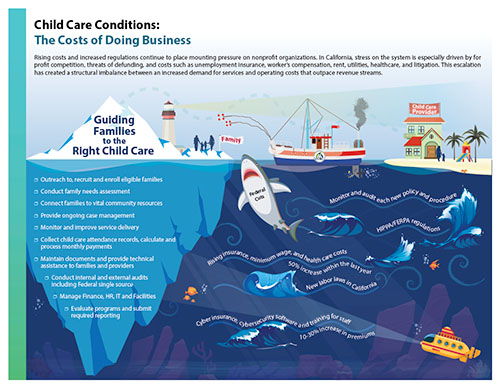
Rising costs and increased regulations continue to place mounting pressure on nonprofit organizations. In California, stress on the system is especially driven by for profit competition, threats of defunding, and costs such as unemployment insurance, worker’s compensation, rent, utilities, healthcare, and litigation. This escalation has created a structural imbalance between an increased demand for services and operating costs that outpace revenue streams.
Recent attempts by private equity (PE) firms to enter the child care sector raise significant concerns for children and families. The child care field has been built over decades through federal, state, local, and philanthropic investments that support a broad system of family services and community infrastructure. This brief outlines the background of PE involvement and explains the risks that such investment poses to the child care sector.
Rising costs, declining enrollments and rates that do not keep up with inflation is resulting in child care deserts. California saw a 30% decline in licensed family child care homes after the recession (37% in Los Angeles County) and a further 14% decline between 2020 and 2021 in California. Without a sustainable source of funding licensed family and center-based care will continue to close their doors, placing an increased strain on working families to find quality care in their community.
Hear the story of a survivor of domestic violence (portrayed by an actor) as she attempted to access services vital to her survival.
A collaborative webinar in April 2024 presented the results and recommendations from a statewide evaluation of policy, program and services for survivors of domestic violence. Recommendations for improvement are presented from the funder, research and most importantly from the parent survivor perspective.
CCRC’s Research Division is invested in ensuring the most equitable and inclusive methods possible. We ensure the inclusion of a diverse range of community and stakeholder input to facilitate the development of programs and policies that have the highest possible level of relevance and impact for our communities. Our diverse and talented team of researchers bring a diverse range of backgrounds and skillsets to each project.




















20001 Prairie Street
Chatsworth, CA 91311
818-717-1000
[email protected]
www.ccrcca.org/research
Mon-Fri: 8am – 5pm
Sat-Sun: Closed